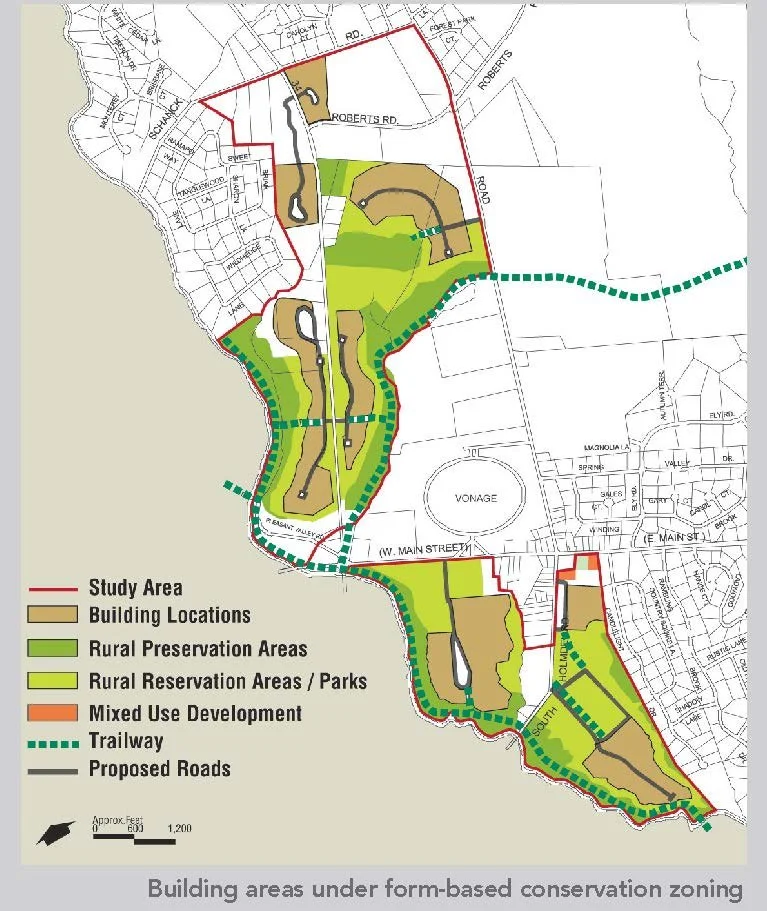
Form-Based Conservation Zoning, Holmdel Township, NJ

CLIENT: TOWNSHIP OF HOLMDEL

Overview
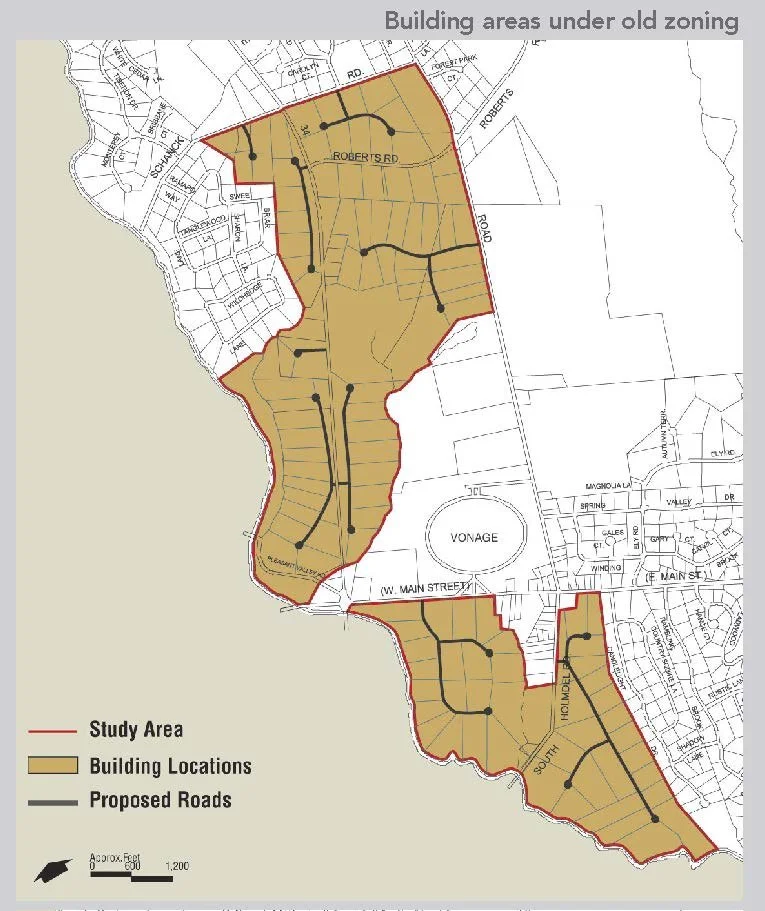
Building areas under old zoning

Holmdel Township, a suburban community in central New Jersey’s rapidly growing “wealth belt,” was faced with the imminent development of its last 500 acres of unprotected rural lands in an environmentally sensitive area surrounding a historic hamlet center. The existing zoning required a minimum lot size of four acres, which would have resulted in large-lot sprawl that would not have fulfilled longstanding Township objectives to preserve open space and protect the character of the hamlet. The Township, with the assistance of a Smart Future grant from the State of New Jersey, retained Phillips Preiss and A. Nelessen Associates to create a design program and accompanying zoning regulations that would maintain the same total lot yield while utilizing neotraditional and conservation cluster subdivision design principles to create a new model of suburban development, including a small mixed-use project adjacent to the historic hamlet. After working closely with developers and other stakeholders, the result was a master plan amendment and form-based conservation zoning regulations that specified the location and typology of buildings, public spaces and conservation areas.
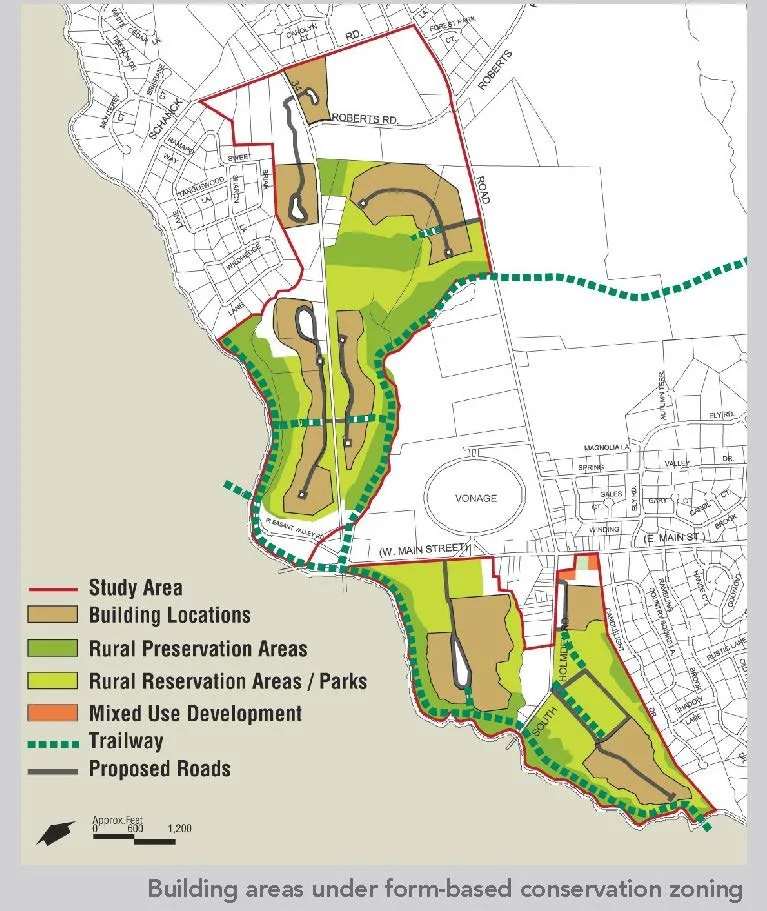
Building areas under form-based conservation zoning

The public benefits will be significant: sixty-five percent of the area is to be preserved as open space, greenway trails will be provided to link the developments to one another and to the village, and several new parks will be built, all tightly integrated into the design of the projects. Most of all, the new regulations preserve forever the important natural areas surrounding the hamlet while providing for a contextual extension of the hamlet. The program was the recipient of a Monmouth County Planning Board Merit Award.

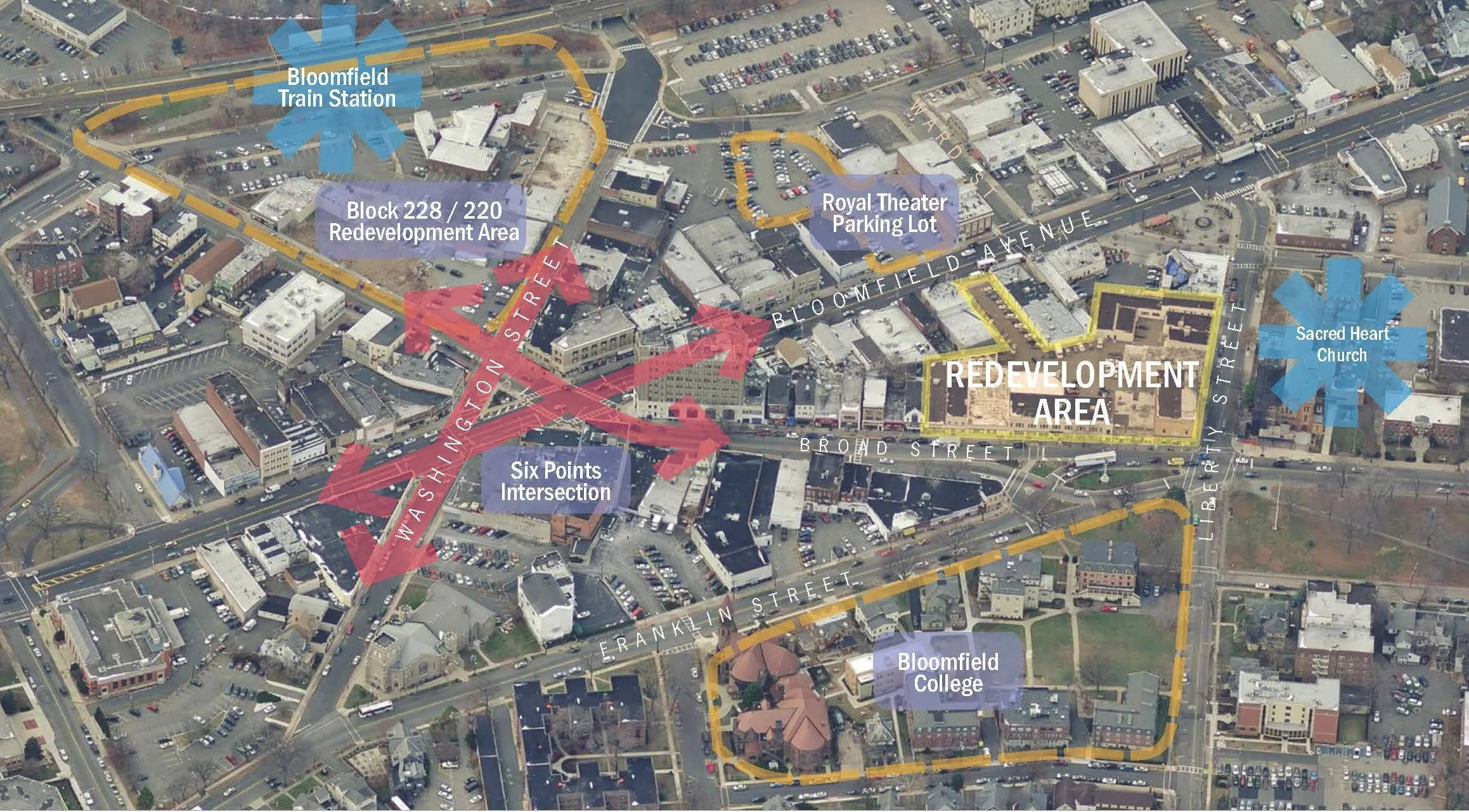
Township of Bloomfield Master Plan, Planning and Redevelopment Services

CLIENT: TOWNSHIP OF BLOOMFIELD

Overview

The Township of Bloomfield is a fully developed, transit-accessible municipality located just west of New York City. Phillips Preiss has provided a full range of planning and redevelopment services to the Township for over two decades. Most recently, Phillips Preiss led the preparation of the 2025 Bloomfield Master Plan, a forward-thinking, community-driven document that was officially adopted in April 2025. The Plan was honored with the 2025 New Jersey Planning Officials Achievement in Planning Award.

Phillips Preiss continues to provide strategic guidance and technical expertise to the Township on its compliance with New Jersey’s affordable housing obligations and various planning efforts. Phillips Preiss has also played a central role in advancing the Township’s redevelopment goals. Over the years, the firm has conducted numerous Area in Need of Redevelopment Studies, prepared Redevelopment Plans, guided implementation strategies, and has advised on open space and development projects.

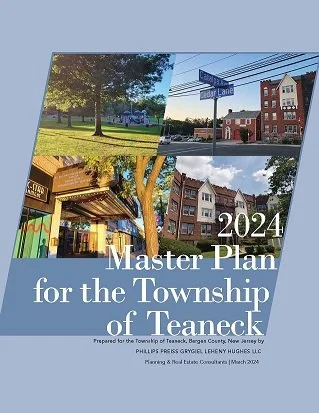
2024 Master Plan for the Township of Teaneck

CLIENT: TOWNSHIP OF TEANECK

Phillips Preiss led the preparation of a new comprehensive Master Plan for the Township of Teaneck in close collaboration with a Master Plan Steering Committee and the Planning Board.

Overview

The planning process included a public outreach process through bilingual online surveying, community forums and workshops, interviews with community and institutional stakeholders, and extensive public comment opportunities. The Master Plan recommended that new development be concentrated along existing bus routes and commercial corridors. It also recommended best practices for future redevelopment planning processes.

The Master Plan addressed wide-ranging land use, design, economic development, mobility, and historic preservation topics, providing detailed objectives and implementable recommendations to achieve them.

The Planning Board unanimously adopted the Master Plan in January 2025. The Plan subsequently received the 2025 New Jersey Planning Officials Achievement in Planning Award.
Highlands CBD Redevelopment Plan

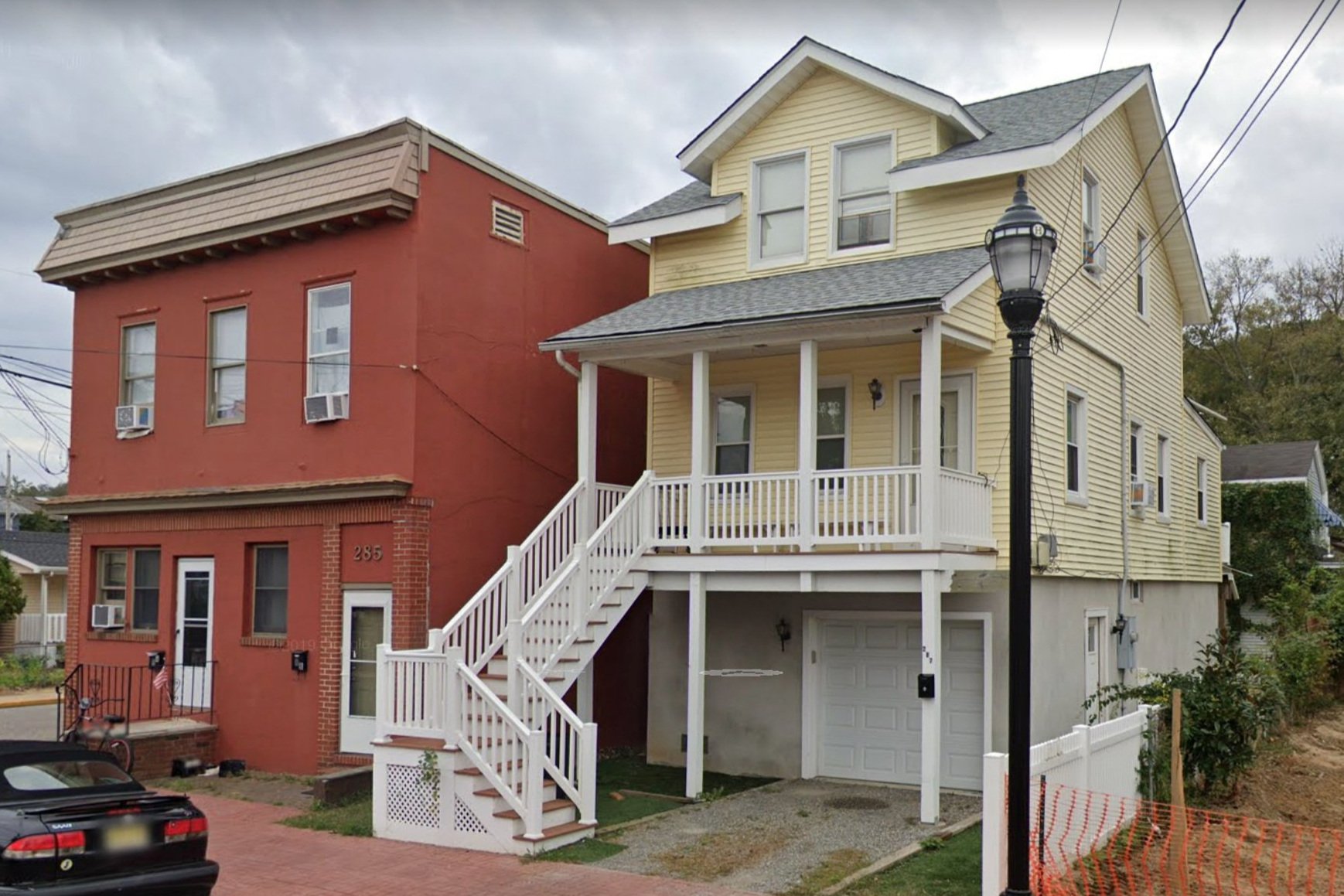
The Borough of Highlands, located along Sandy Hook Bay and the Shrewsbury River, has a compact main street (Bay Avenue) with small-scale lots anchoring the downtown, ferry service to New York City, a substantial waterfront, and easy access to Atlantic Ocean beaches. However, nearly the entire downtown lies within the FEMA AE flood zone, making ground-floor retail  prohibitively expensive. Many properties were badly damaged by flooding from Hurricane Sandy in 2012, and few businesses have reopened. In 2018, the Borough overhauled the downtown zoning, hoping to spur more restaurants, retail, and activity through mixed-use development. However, onerous parking requirements and restrictive height and FAR limits, combined with stricter floodproofing requirements, continued to make it nearly impossible to build a mixed-use building with ground-floor retail. Most recent construction and renovations have been single-family homes with front garages, resulting in less pedestrian activity on downtown sidewalks.

Examples of recent home construction and renovations to place living spaces above the Design Flood Elevation, resulting in a growing “garagescape” along Bay Avenue, the retail spine of Highlands. Some homes have a more friendly appearance than others.

Example of a house with its living areas raised above Design Flood Elevation, with a friendly second floor porch that is linked to the public sidewalk with a prominent staircase.

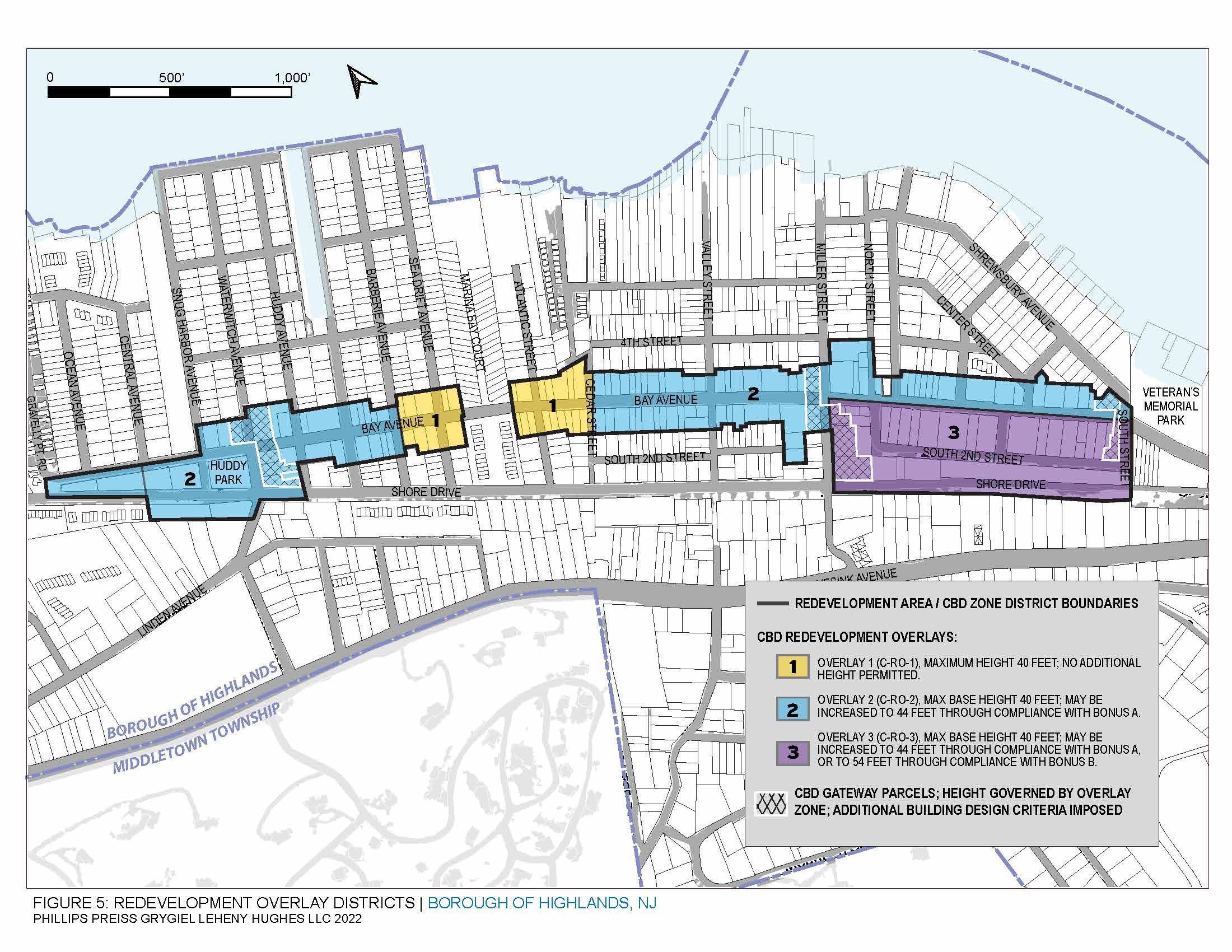
Through a competitive bidding process, Highlands retained Phillips Preiss to determine if a redevelopment approach could be used to spur new investment across downtown. After careful analysis of existing zoning, built form, building heights, and patterns of recent construction and renovations, the firm suggested a series of dramatic changes. Parking ratios were reduced, FAR was removed as a factor, and maximum permitted building coverage was increased. Most significantly, the firm created an optional height bonus program for several overlay areas where larger-scale new construction could be added downtown without unduly impacting adjoining single-family areas. The two-tiered bonus program awards higher heights in exchange for features that contribute to active, inviting, downtown-style streetscapes, including attractive, landscaped front “pocket parks” or plazas to create “breathing room” along the narrow, constrained Bay Avenue sidewalks and active uses on a floodproofed “Lowest Floor” – either the ground floor or the second floor. The additional heights will allow for more residential units on upper floors, creating more foot traffic and helping support new restaurants and retail.

The bonus program requires that if the active use is provided on the second floor, over an open level of parking, a front porch or deck with a substantial staircase or a series of terraced ramps is required within the front setback to maintain an inviting connection to the public sidewalk. In addition, front setback areas must have porous paving and landscaping for infiltration as well as seating areas to foster activity. The top floor of buildings must be stepped back to help reduce the perceived height and bulk. The Plan was well received and unanimously adopted in May 2022.

Aerial view of downtown Highlands, showing the narrow lots and regular grid of pedestrian-friendly streets.

Raritan Sustainable Economic Development Plan

Client: New Jersey Transportation Planning Authority (NJTPA)

Downtown Raritan Vision Plan

Downtown Raritan Vision Plan

Raritan Vision Plan

Raritan Vision Plan

Phillips Preiss was part of a project team led by FHI Studio that was selected by the North Jersey Transportation Planning Authority (NJTPA) to prepare a sustainable economic development plan for the Borough of Raritan, New Jersey as part of NJTPA’s Planning for Emerging Centers Program. Conveniently located in Somerset County’s core in central New Jersey, the Borough sought to create a plan that would allow them to maintain and expand existing downtown employment and economic activity, while retaining their historic, small-town character and capitalizing on their highly connected street network and potential waterfront connections to the Raritan River. Phillips Preiss’s primary role was to evaluate economic and market conditions within and around the Borough in order to provide insights and recommendations that would advance the goals of the plan, which presented a community-driven 10-year economic, land use and multi-modal vision for the Borough with a focus on supporting both existing and new residents and businesses. The Raritan Sustainable Economic Development Plan was honored with a 2021 Excellence in Planning Award by the Somerset County Planning Board.

Honeywell Redevelopment
Honeywell Redevelopment_plan.jpg
Honeywell Redevelopment.jpg

Phillips Preiss worked with the Morris Township Planning Board to plan the redevelopment of the 147-acre former Honeywell International Inc. corporate campus. The work included amending the Land Use Plan Element of the Master Plan to create a new Office and Research Laboratory/Planned Unit Development (OL-40/PUD) designation. The PUD permits a mix of office, laboratory and townhouse uses subject to a series of development standards and contingent upon the submission of a general development plan.

Green at Florham Park: Planning Services
Green at Florham Park office_render_600w.jpg
Green at Florham-Park_site_plan_600w.jpg

Phillips Preiss has provided planning services including fiscal and community impact analyses to Rockefeller Group with regard to its master planned redevelopment of a 268-acre former Exxon-Mobil corporate campus site in Florham Park known as The Green at Florham Park. The development is now home to the BASF North American Headquarters, Summit Medical Group, and The New York JETS . The Green at Florham Park is also the future home of AVE Florham Park, which provides 256 corporate suites, The Archer Hotel, a sophisticated 161-key boutique hotel, Summit Medical Group / MD Anderson Cancer Center, providing world class cancer care, and a residential community. 

Morris Township Reexamination Report
MorrisTwpReexam_2.jpg


The firm prepared a Master Plan Reexamination Report for the Township of Morris in 2017. Phillips Preiss worked closely with the Planning Board to catalogue progress that had been made on the Township’s previous plan, describe the changes experienced in the municipality over the last ten years, and to develop recommendations for future land use. The recommendations were broken down into a short-, medium-, and long-term implementation schedule.

Fort Monmouth Planning Services

Client: Fort Monmouth Economic Revitalization Authority (FMERA)

Fort Monmouth Planning Services_v2.jpg
Fort Monmouth Planning Services_2.jpg
Fort Monmouth Planning Services_3.jpg

Since 2011, Phillips Preiss has provided ongoing planning consulting services to the Fort Monmouth Economic Revitalization Authority (FMERA). FMERA is the entity responsible for overseeing the redevelopment of Fort Monmouth with an emphasis on job creation, economic development, conservation of natural resources, and housing creation. Phillips Preiss has provided planning advisory services to FMERA including the preparation of redevelopment plans, amendments to the Reuse and Redevelopment Plan, and open space analyses among other tasks.

Fort Monmouth Historic Preservation Design Guidelines

Client: Fort Monmouth Economic Revitalization Authority (FMERA)

Fort Monmouth Historic Preservation Design Guidelinesv2.jpg

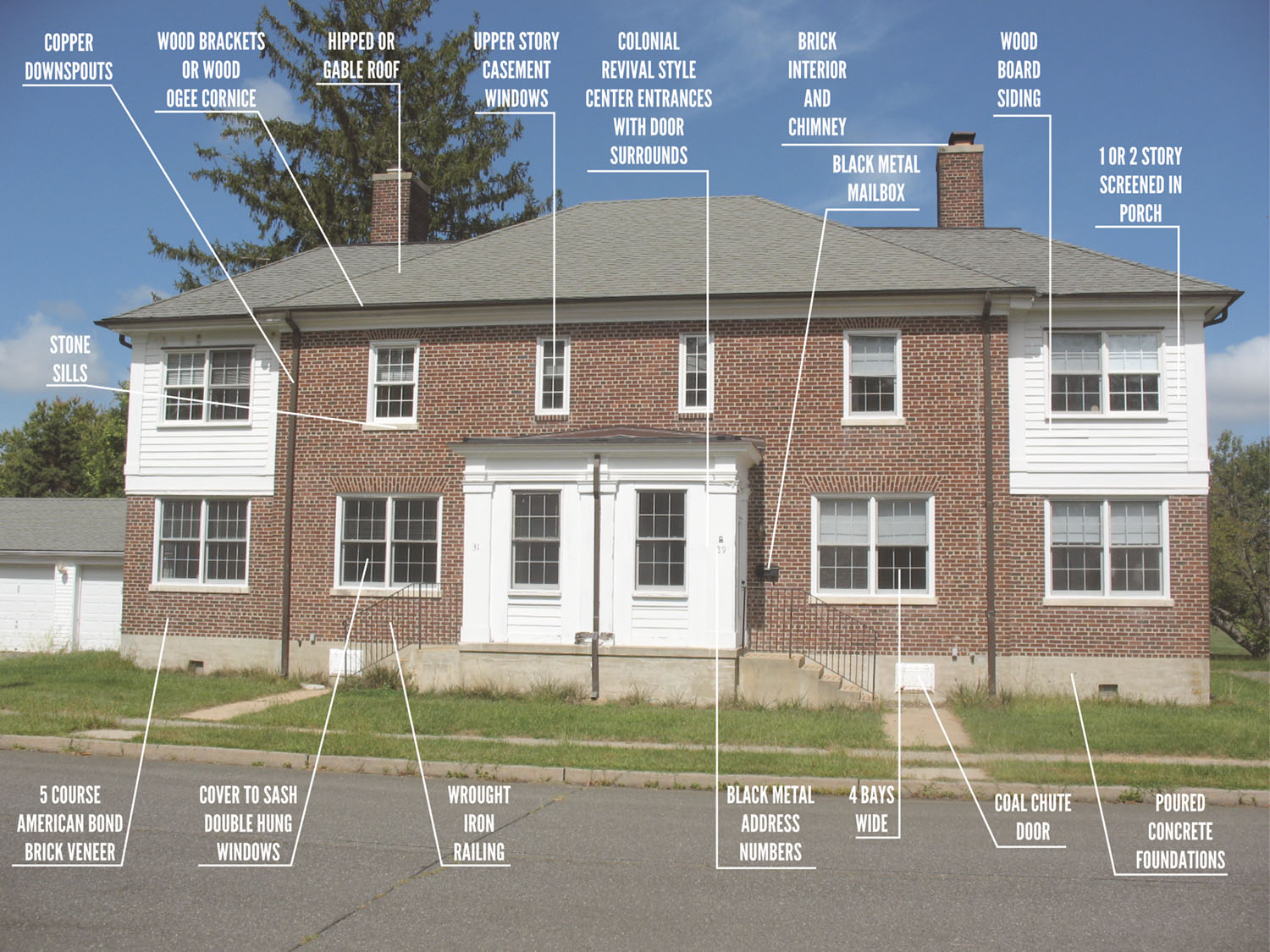
As part of its ongoing planning consulting services for the Fort Monmouth Economic Revitalization Authority (FMERA), Phillips Preiss prepared design guidelines for the historic resources in the former Fort Monmouth.  The Historic Preservation Design Guidelines provide details on historic features and convey recommendations on renovations, restorations, and new additions to Fort Monmouth’s contributing historic resources.

Adaptive Reuse and Planning Study for Englewood

Client: City of Englewood, NJ

Overview

Phillips Preiss was retained by the City of Englewood to conduct adaptive reuse feasibility analyses for two key public buildings: the Liberty School, a handsome historic school building, and the Wright Arena, a semi-enclosed ice rink. Phillips Preiss provided the City of Englewood with a feasibility analysis for several reuse ideas which had been advocated by various constituencies in the community.